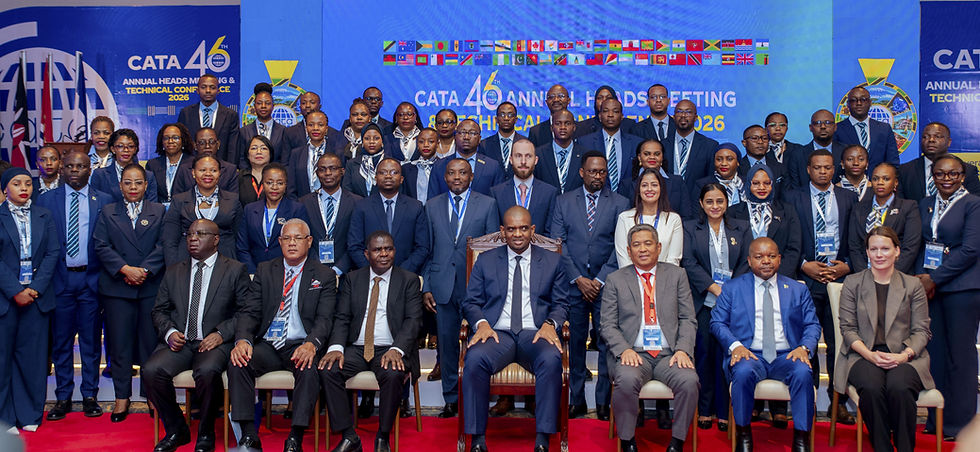
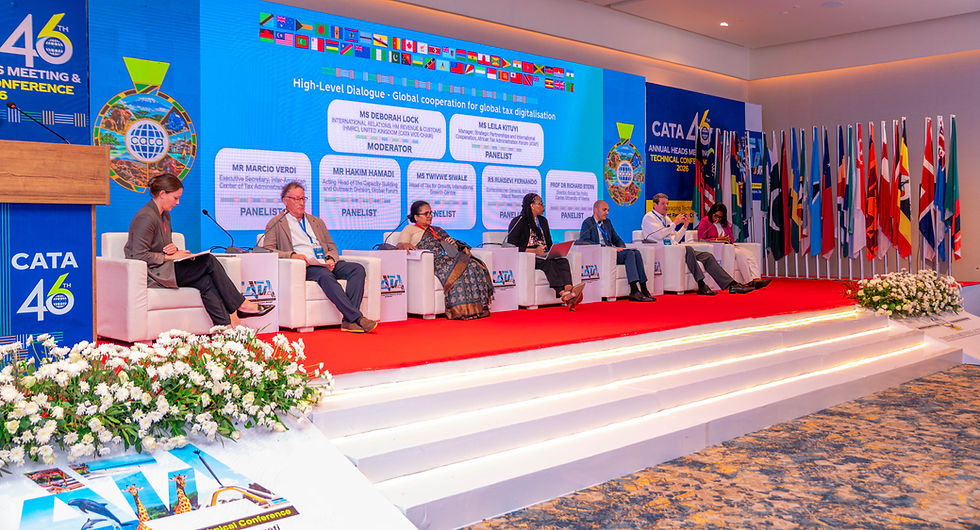
A Successful and Strategic Week for CATA | 27–30 April 2026

The past week marked a highly productive and strategically significant period for the Commonwealth Association of Tax Administrators (CATA), with three closely linked meetings held in London. The Regional Directors and Country Correspondents Meeting, the AI Taskforce Meeting, and the Management Committee Meeting together strengthened coordination, advanced innovation, and delivered important strategic and institutional outcomes.

Collectively, these meetings demonstrated the strength of CATA’s collaborative operating model—connecting regional insight, member‑driven technical work, research partnerships, and strategic oversight to support effective capacity‑building and technical assistance across the Commonwealth.

The meetings were convened under the leadership of CATA President, Dr Abu Tariq Jamaluddin, and CATA Chairman, Mr Rohit Ramnawaz, with the support of the Vice Chair of the Management Committee, Ms Deborah Lock. Their engagement throughout the week provided continuity of vision and reinforced CATA’s commitment to collaboration, strategic focus, and practical delivery for members. The

meetings were supported by the CATA Secretariat, led by Executive Director Dr Esther A.P. Koisin, ensuring coherence across strategic discussions, technical initiatives, and delivery planning.
Enabling Delivery Across the Commonwealth: Regional Directors and Country Correspondents, 27–28 April 2026

The Regional Directors (RDs) and Country Correspondents (CCs) Meeting plays a central role in ensuring that CATA’s work is effectively delivered, regionally responsive, and aligned with member needs.
The meeting brought together Regional

Directors, Country Correspondents, and the Secretariat to strengthen coordination across regions and countries. Discussions focused on regional and country‑level updates, emerging priorities, delivery experiences, and opportunities to enhance participation and impact of CATA’s programmes.
Key areas of focus included:
Close collaboration with the Secretariat to support smooth delivery of capacity‑building programmes and technical assistance;
Regional coordination and sustained member engagement;
Review of progress and requirements of technical working groups;
Preparations for major upcoming events, including the 2026 Annual Heads Meeting and Technical Conference.
Through their close engagement with members and continuous collaboration with the Secretariat, Regional Directors and Country Correspondents play an indispensable role in translating CATA’s priorities into practical, on‑the‑ground delivery across the Commonwealth.
Advancing Innovation Through Partnership: AI Taskforce, 28–29 April 2026
A major highlight of the week was the successful launch and first formal meeting of the CATA AI Taskforce, established in collaboration with the International Growth Centre (IGC).
The Taskforce brings together CATA members, technical experts, and research partners to support tax administrations in the responsible and practical adoption of artificial intelligence (AI). Discussions were strongly grounded in member experience, with an emphasis on identifying high‑value use cases, managing risks, and ensuring that AI initiatives deliver tangible outcomes.
The meeting also benefited from expert input by Dr Richard Stern, Director of the Global Tax Policy Center at the Vienna University of Economics and Business, who contributed perspectives on AI adoption in tax administration, drawing on international experience. His reflections complemented the member‑led and IGC‑supported discussions by highlighting the importance of clearly defined use cases, strong data foundations, legal clarity, human oversight, and explainability—particularly where AI applications may affect taxpayer rights.
During the meeting, participants:
Confirmed the Taskforce’s mandate, objectives, and operating principles;
Agreed on priority focus areas, including revenue mobilisation, compliance risk identification, audit effectiveness, internal operations, and taxpayer services;
Discussed the importance of digital and data readiness as prerequisites for effective AI use;
Established technical workstreams with agreed leadership and responsibilities;
Developed an initial 90‑day workplan setting out early deliverables and next steps;
Agreed on operating modalities, reporting arrangements, and coordination with partners.
Overall, the AI Taskforce discussions reinforced a shared commitment to moving beyond experimentation toward practical, responsible, and scalable AI use, led by members, supported by IGC, and informed by relevant external expertise.
Strategic Direction and Governance: Management Committee, 29–30 April 2026
Held under the leadership of CATA Chairman, Mr Rohit Ramnawaz, with strategic guidance from President Dr Abu Tariq Jamaluddin and Vice Chair Ms Deborah Lock, the Management Committee Meeting provided formal strategic direction, oversight, and decision‑making, building on the discussions from the preceding meetings.
The Committee also received an external perspective from Dr Richard Stern (Vienna University of Economics and Business), who shared observations on digitalisation and data governance in tax administrations. The discussion supported the Committee’s deliberations on strengthening the institutional and technical foundations needed for effective digital reform and reinforced CATA’s openness to collaboration with research institutions, under the direction of its governing bodies.
A key outcome of the meeting was the strengthening and clarification of mandates for several technical working groups, reinforcing CATA’s member‑driven and implementation‑focused approach. The Management Committee:
Approved the establishment of the AI Taskforce, including its mandate, Terms of Reference, membership, and reporting arrangements.
Endorsed an expanded mandate for the E‑Invoicing Working Group, enabling it to move beyond experience‑sharing into structured, demand‑driven technical assistance, supporting members with policy design, technical architecture, piloting, and capacity building.
Endorsed a focused mandate for the Working Group on Cryptocurrencies and Digital Assets, authorising the development of a Crypto Audit Guide and Risk‑Based Audit Toolkit to assist members in addressing emerging compliance risks.
Endorsed the Work Plan of the Working Group on Cybersecurity, recognising the growing importance of cyber resilience for tax administrations and reinforcing support for practical guidance, capacity building, and information‑sharing on cybersecurity risks and controls.
Reaffirmed the mandate of the Automatic Exchange of Information (AEOI) Working Group, supporting members in the effective implementation and use of exchange of information standards.
In addition, the Committee:
Reviewed progress against previous action items;
Endorsed CATA’s FY 2026–2027 programme priorities;
Reviewed programme delivery and flagship initiatives;
Endorsed CATA’s Annual Report;
Held strategic discussions on governance, finance, communications, and institutional sustainability;
Advanced planning for the 2026 Annual Heads Meeting and Technical Conference.
How CATA Works: From Strategy to Delivery
CATA’s effectiveness is built on strong collaboration across its structures:
The Management Committee provides strategic direction, oversight, and institutional decision‑making.
The Secretariat coordinates programmes, partnerships, and delivery.
Regional Directors and Country Correspondents ensure relevance and effective delivery across regions.
Technical and research partners, including the International Growth Centre (IGC) and academic institutions, contribute analytical insight and specialist expertise.
This integrated model ensures that CATA’s priorities are translated into meaningful, practical support for tax administrations across the Commonwealth.
Why Artificial Intelligence Matters for Tax Administration
Tax administrations face increasing complexity—from digitalised economies and growing data volumes to more sophisticated compliance risks. Artificial intelligence, when applied responsibly, can strengthen revenue mobilisation, improve risk‑based compliance, enhance operational efficiency, and support better taxpayer services.
At the same time, AI adoption must be grounded in transparency, accountability, data protection, and public trust. Through the CATA AI Taskforce, members are working collectively—supported by IGC and informed by external expertise—to ensure that AI is applied ethically, pragmatically, and in ways that deliver real value.
Looking Ahead
Taken together, the three meetings represent a coherent and highly successful week for CATA. Delivery coordination was strengthened through the Regional Directors and Country Correspondents Meeting, innovation was advanced through the AI Taskforce, and strategic oversight was reinforced through the Management Committee.
With strong leadership, active member engagement, and carefully balanced collaboration with partners and external experts, CATA is well positioned to continue supporting tax administrations across the Commonwealth in an increasingly complex and digital environment.